Blue Hole Agency at bjij
iBiom Inc. and the Fiction of Longevity
At Blue Hole Agency, the art group iBiom Inc.—Tata Gorian, Anna Prilutckaia, Evgenia Zolotnikova, and Olga Zubova—turns its corporate alter ego toward one of the most seductive and fast-growing global narratives: longevity. Presented at bjij, an itinerant art gallery currently housed in a Yerevan basement, the project investigates how the desire for extended life is produced, packaged, circulated, and culturally consumed.
The artists situate their work within a moment where longevity saturates the media. They point to the popularity of biohacking, the spectacle of individuals wired to devices and surviving on supplements, and even the resurgence of vampire myths portraying immortality as boredom and existential fatigue. Social media has become a repository of youth-preserving rituals, and high-profile summits around the world promise access to longer, more meaningful lives. The name of entrepreneur Brian Johnson, who publicly pursues immortality, came up often during their exhibition: many visitors recognized his story instantly. As the artists note, “on his website you can even buy a cap with the slogan Don’t Die.”
This cultural field has expanded into art institutions as well—for instance, the recent Republic of Longevity at the Milan Triennale. Within this global landscape, iBiom Inc. does not merely echo the fascination with slow aging but instead twists it, revealing its undercurrents and blind spots.
Entering the Agency: A Choreographed Fiction
The encounter begins the moment one steps into the space. Visitors are greeted by Blue Hole Agency staff, performed by members of iBiom Inc. themselves. They introduce the agency, outline its mission, and guide guests through its speculative infrastructure with the confident tone of wellness consultants or startup evangelists.
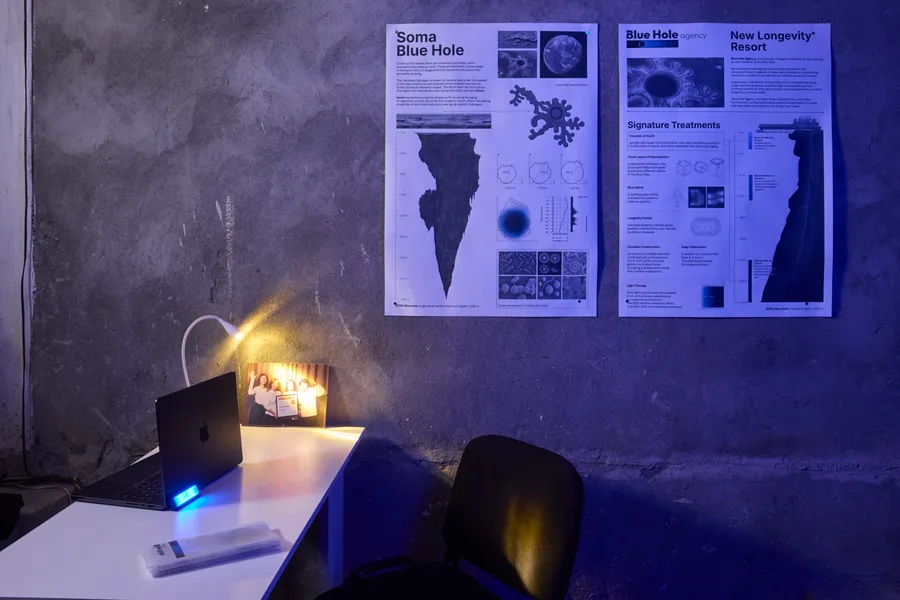
Immediately overhead, stretched across the ceiling, glows the slogan WELCOME TO LONG LIFE, setting the affective expectation of a corporate initiation. To the right, a mirror inscribed with “See the hidden depth” reframes the visitor as both observer and specimen, encouraging self-examination within the logic of optimization. Next to the mirror hangs a diagram of the blue hole—a scientific-looking cross-section of its depth, strata, and “energetic layers.” The diagram mimics the visual authority of geological or medical illustration, lending pseudo-empirical weight to the agency’s claims. Together, the mirror and the diagram operate as a dual invitation: to look inward and downward simultaneously, merging self-surveillance with speculative geology.
Opposite this arrangement stands a familiar office object transformed into an artifact of wellness mythology: a water cooler dispensing SOMA, branded as “longevity water from the depths of the Blue Hole.” The cooler, with its corporate sticker and staged functionality, anchors the fiction in the everyday—suggesting that the path to longevity may be as simple (and purchasable) as staying hydrated.
Deeper into the space, the visitor encounters a video of Brian Johnson, the entrepreneur whose anti-aging regimen has become a global media performance. His presence situates the installation within the real-world spectacle of self-optimization. Near this screen, a black-curtained cabin invites a more immersive descent. Inside, footage captured within an actual blue hole fills the dark space with a slow, vertiginous plunge into the deep. Above the video hovers the text EXIT TO THE SURFACE, which reads simultaneously as an emergency instruction, a metaphor, and a critique of the escapist logic underlying longevity culture.
To the right of the cabin stands a desk containing a framed photograph of the iBiom Inc. team and a certificate from the Global Healthspan Summit, where their fictional Blue Hole Resort was honored “in recognition of Outstanding Achievement as the Most Breakthrough Longevity Project,” suggesting a corporate genealogy of success and legitimacy into the broader wellness economy.
Here, visitors are offered agency brochures and a “longevity test,” which promises to identify which procedures best suit their personal profile. The design of these materials is so precisely aligned with existing wellness marketing that the speculative fiction becomes momentarily indistinguishable from an honest service.
On the opposite wall, another station presents the Blue Hole Longevity Diet: an array of stones, corals, and gelatinous biomorphic forms described as nutritional or energetic resources drawn from abyssal depths. This improbable diet, at once absurd and meticulously framed, exposes the exoticization strategies commonly used to legitimize premium wellness products.
The entire environment is orchestrated as an onboarding ritual—part corporate welcome center, part pseudo-scientific lab, part spiritual retreat—offering visitors the opportunity to inhabit, if only briefly, the seductive fiction of enhanced life.
Blue Zones, Blue Holes, and the Inversion of a Narrative
While the project references the now-iconic Blue Zones described by Dan Buettner—those places where people supposedly live longer thanks to environment, nutrition, and community—the artists use this trope only as an initial point of entry. Their real protagonists are blue holes, the underwater sinkholes where nonhuman organisms survive under extreme, inhospitable conditions. By introducing blue holes as the “shadow twin” of blue zones, the artists invert the longevity narrative: the bright promise of a longer life gives way to the murky depths of survival beyond the human frame. As they put it, “we turned the narrative inside out and got its dark, otherworldly double.”
This shift allows the project to question the anthropocentric optimism embedded in wellness culture. By looking instead at life that persists in corrosive, oxygen-poor ecosystems, the artists point toward radically different models of endurance—ones that resist romanticization.
Local Terrain, Global Myths
Despite its speculative dimensions, the project is anchored in concrete geography. The artists wanted their investigation of longevity to have a physical, experiential grounding. Armenia, with its mountainous terrain, mineral waters, and long tradition of spa culture, became a natural site of inquiry. Their initial interest was drawn to the “Daisy” (Маргаритка)—a striking hydrotechnical structure at the Kechut reservoir. Only later did they learn that there are two such structures in Armenia, one near Jermuk. This architectural curiosity could be seen as an artificial blue hole.
But as they studied the site, a more troubling history surfaced: during the Soviet construction of the reservoir, the old village of Kechut, including its cemetery and khachkars, was submerged. Once the artists learned about this submerged trauma, they realized they could not make the Daisy the central focus of their inquiry. The project shifted toward Jermuk, with its intricate mix of waters, rituals, and memories.
A Tour as a Method of Thinking
One of the most distinctive gestures in Blue Hole Agency is the guided longevity tour. The artists organized a trip of nearly twenty participants, rented a minibus, and led them through speculative practices that blended geology, ritual, and wellness rhetoric. The group describes how effortlessly people joined the process and how many asked when the next tour would occur; the fiction was convincing enough to be taken at face value.
A memorable moment came when a Jermuk resident, Artur, spontaneously joined the group. He later revealed he was deeply committed to his own longevity routines, including cold-water immersion, hundreds of push-ups, breathing practices, and meditation, and that he had come to the Arpa gorge to perform spiritual exercises for ill friends. Drawn to the group, he integrated into the tour as though it were his natural community. In Jermuk, he lacked a circle with whom he could share his practices; for a brief time, the artists and participants became that community. This encounter revealed how the desire for extended life is not only a media narrative or a commercial industry but also a lived, personal search.
The Corporate Mask as a Tool of Critique
Central to iBiom Inc.’s methodology is the persona of a fictional corporation. This format enables them to reproduce, from within, the logic of the capitalist market, where every person becomes a client, relationships turn into services, and any event becomes an opportunity for a new product. The artists explain that the wellness and longevity industries are no different from other market sectors—they are full of startups, services, branded methodologies, and curated experiences. By assuming the role of a travel agency with brochures, certificates, a branded water cooler, and a television endlessly streaming LongeviTV’s longevity content—just like in any typical office reception zone—the group reproduces the atmosphere of service culture so convincingly that its speculative core becomes almost indistinguishable from its real counterparts.
Their fluency in the visual and rhetorical language of advertising is no accident. All participants have professional experience in commercial creative industries, and as they say, “these formats live deep within us, so we reproduce them easily.” This capacity allows them to create what they describe as “Trojan horses”: works that appear fully aligned with capitalist grammars while undermining them from within.
The Microbiome as a Symbol of Radical Personalization
Although iBiom Inc.’s earliest projects centered directly on the microbiome, most notably iBiom Box, a speculative, personalized device based on bacterial cultures from smartphone screens, the motif persists, even as its role has shifted. Today, the microbiome symbolizes the radical personalization that dominates wellness markets: the dream of having products, services, diets, and even partners tailored precisely to one’s biological profile. In their earlier project, iBiom Box, the artists even proposed a speculative “microbiome Tinder” that matched romantic partners based on microbial compatibility — a concept that once generated intense audience interest. Though unrelated to Blue Hole Agency, this earlier idea encapsulates the collision of intimacy, biology, and consumer desire that defines the broader logic of radical personalization within wellness and tech cultures.
Longevity Between Research and Fantasy
The artists articulate a deep ambivalence within the longevity industry. On one side lies serious biomedical research and undeniable scientific progress. On the other hand lies a vast domain of speculation, uncertainty, and hype. They describe the field as “a movement in the fog”—a mixture of established knowledge, unproven claims, and unknown horizons. It remains unclear which longevity interventions will prove effective and which will dissolve into the category insiders themselves call “the gamble.”
Beyond the science lies a philosophical quandary: Should humans live dramatically longer lives, and what would such an expansion of time mean for identity, social structures, or planetary resources? Literary and artistic explorations of immortality, from Karel Čapek’s The Makropulos Affair to contemporary cinema, suggest that very long life often leads to exhaustion, disorientation, and the collapse of meaning. Longevity, as the artists argue, is as much a cultural dream as a biological possibility.
The spectacle of the industry, exemplified by Brian Johnson’s public self-experiments, further complicates its credibility. The line between scientific pursuit and media performance grows increasingly thin.
bjij as an Infrastructure of Speculation
The shifting, provisional nature of bjij’s spaces resonates deeply with the instability and mutability of longevity narratives. Yet as the curators Svetlana Sidorova and Areg Arakelyan describe, mobility is not the defining feature; scale is. Started in 2024, the gallery’s current format—“a space one and a half meters by one and a half”—sets strict physical limits that paradoxically enable artistic freedom. “You are limited,” the curators say, “but you can be anywhere.” The constraints of this miniature, movable cube create a curatorial logic where only artists capable of producing a total installation within such a tight frame can participate. This specificity, rather than the gallery’s mobility, shapes their selection process.
For Blue Hole Agency, this compact architecture became a strength. The curators explain that earlier exhibitions relied on familiarity—inviting friends or artists they knew well. But as the gallery became smaller, more portable, and more conceptually defined, they turned to artists who could inhabit and transform such a space entirely. Their trust in iBiom Inc. was long-standing, and the artists’ ability to produce a complete fictional environment under intense time constraints made them a natural fit.
The curators note that the basement environment itself profoundly shaped the public’s experience. The cold concrete, the smell of dampness, and the quasi-abandoned atmosphere misled many visitors into believing they had entered a real office. The simulation worked too well: “People came in, opened the door, and thought they had walked into an actual agency. Why not? Everything is underground now—Wildberries, micro-offices, whatever.” The space evoked memories of improvised 1990s Armenian offices operating out of half-finished apartments, repair rooms, or storage units. This cultural resonance amplified the believability of iBiom Inc.’s corporate fiction.
The entire mise-en-scène—performed consultants, brochures, the SOMA water cooler, the “longevity tests”—became even more convincing within such an ambiguous architectural frame. Had Blue Hole Agency been shown in a conventional gallery or museum, visitors would have recognized it as art immediately. “Here,” the curators emphasize, “people could doubt. This floating frame, this semi-illicit basement architecture, worked in favor of the artists.”
Their reflections reveal why speculative and research-driven projects feel at home in bjij. The collective describes the gallery as a “white hole in space”—a small chamber that constantly changes identity and absorbs whatever is placed inside it. Each exhibition becomes a kind of portal: a provocation, a shift in perception, an entry into a parallel dimension. In this sense, the gallery is not a fixed institution but a mutable organism. The curators see speculation not as a genre but as a natural mode for bjij: “iBiom Inc. is a speculation of reality—a duplication of the capitalist approach to life, treating everything as a product. They sell you air. And it works.”
In the context of Blue Hole Agency, bjij’s basement became not simply a venue but an essential component of the fiction. Its architectural ambiguity allowed the project to oscillate between art and reality, between critique and simulation, between immersion and disorientation. The gallery’s very limitations—its smallness, its coldness, its resemblance to an improvised office—intensified the work’s conceptual punch.
Toward the Next Episode
iBiom Inc. plans to expand the geography of its fictional corporate offices and research institutes, though the direction remains open-ended. Their themes, they say, emerge from coincidences: conversations, observations, personal concerns, and the shifting landscapes of global culture. This openness ensures that their practice remains responsive to the evolving tensions between technology, biology, and belief.
A Critical Take on the Longevity Imaginary
Blue Hole Agency exposes longevity not as a scientific certainty but as a cultural fiction woven from hope, science, marketing, desire, and fear. It reveals how easily such narratives take hold, how readily they become commodities, and how fully they shape contemporary aspirations.
Ultimately, the project makes one point unmistakably clear: the real issue is not how to extend life, but how the stories around longevity are engineered, branded, and sold—and why we are so willing to accept them as truth.
Authors
- Taguhi Torosyan
- AI Editor